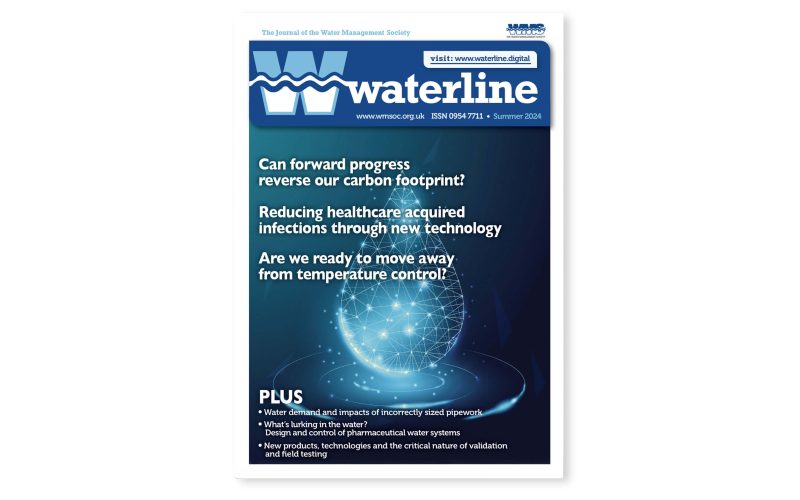
As featured in Waterline Summer 2024

Can forward progress reverse our carbon footprint?
By Kimberly Arbuckle, Key Accounts Manager, Angel Guard
In our continual pursuit of enhancing lives and fostering positive outcomes for all, we are constantly inspired by innovative ideas that offer solutions to pressing challenges. As we navigate through an era where the demands on technology grow more stringent each year, it’s not just about problem-solving anymore; it’s about doing so while minimising energy consumption and curbing carbon emissions. Fortunately, the evolution of technology isn’t just about human convenience anymore; it’s also about extending kindness to our planet, alleviating burdens within our shared spaces, and addressing escalating climate concerns. This article delves into several technologies that not only meet these criteria but also embody a commitment to both efficiency and environmental stewardship.
Heat pumps
Although heat pumps have been around since the 1850s, their recent surge in popularity, particularly in residential and commercial heating applications, reflects their vital role in tackling the climate crisis. One of the key factors driving this trend is the remarkable efficiency of heat pumps, which can generate more energy from electricity than many gas alternatives, despite disparities in unit costs. For instance, a ground-source or air-source heat pump typically yields three units of energy for every unit of electricity consumed. To put this into perspective, imagine that an average UK household requires around 12,000 kWh per year for heating. With a heat pump, that same amount of heat can be provided using just a third of that energy—approximately 4,000 kWh.
However, it’s important to acknowledge a significant limitation of heat pumps: their capacity to deliver and store hot water. Typically, these systems struggle to heat water beyond 50 degrees Celsius, with storage temperatures hovering around 45-50 degrees Celsius. While this range might be suitable for handwashing, bathing and showering, it falls within the optimal conditions for Legionella bacteria growth. To address this concern, a necessary “Anti-Legionella cycle” has been developed, requiring periodic heating to temperatures around 70 degrees Celsius. Despite this measure the ‘jury’ is still out and deciding if this is enough to prevent water-borne pathogens from developing. One thing is sure, the use of low temperature heat pumps in larger premises should be a cause of concern.

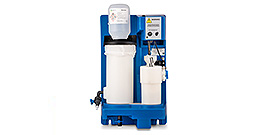
Heat pumps have risen in popularity recently
Capturing heat from waste water
Every day, as showers run and washing machines cycle, the wastewater coursing through the sewers beneath our feet carries valuable energy potential. Through innovative technologies utilising heat exchangers and heat pumps, this otherwise wasted heat can be harnessed to provide sustainable, low-carbon heating or cooling solutions for a variety of buildings, from hospitals to industrial facilities. By preventing energy loss and capitalising on a readily available resource, these systems not only reduce energy consumption and reliance on fossil fuels but also contribute to a significant decrease in greenhouse gas emissions.
Case studies
For example, Scottish Water Horizons spearheaded the installation of the UK’s first heat-from-wastewater scheme at Borders College, Galashiels. This initiative utilises wasted heat from the local sewer system to fulfil the majority of the campus’s annual heating and hot water needs. Similarly, the Stirling Low Carbon Heat Project, a collaborative effort between Scottish Water Horizons and Stirling Council, employs heat-from-wastewater technology alongside a combined heat and power engine to supply sustainable low-carbon heat to a community in Stirling via a district heating network.
Leak detection systems
In the UK alone, nearly 23% of water pumped into public supply systems is lost due to leaks, both within and outside buildings. Advanced digital leak detection devices now offer water companies and service providers the ability to swiftly and accurately identify anomalies in water supply networks. By promptly detecting leaks, these systems enable building owners to expedite remedial actions, preventing wastage and conserving precious resources. Thames Water reports a significant reduction in water consumption, including through the early detection of leaks within customers’ premises, thanks to the deployment of smart meters.
Pipe-in-a-pipe recirculation system
Recirculating potable water within buildings is still performed with a traditional two pipe system using a flow pipe and a completely separate return pipe that pumps unused water back to the heat (or cooling) source to bring it back-up (or down) to temperature for sending out again to all of the outlets. This, as you can imagine, is quite energy inefficient as long pipe runs (even those that are well insulated) can lose up to 10 degrees along the way.
Improving upon this is the inventionof a pipe-in-a-pipe recirculationsystem. This award-winning innovativeproduct places the smaller return pipewithin the outgoing flow pipe andhas a remarkable effect on reducingthe energy usually lost. By constantlyinsulating the return water with thenewly charged flow water it ensuresthat there is a temperature equilibriumthroughout the entire water system,reducing temperature losses to lessthan 1 degree. This helps to ensure thatthe water remains compliant withinsafe temperatures all the way to theoutlets. It also discourages pathogenand biofilm growth whilst using up to50% less energy and carbon usage.
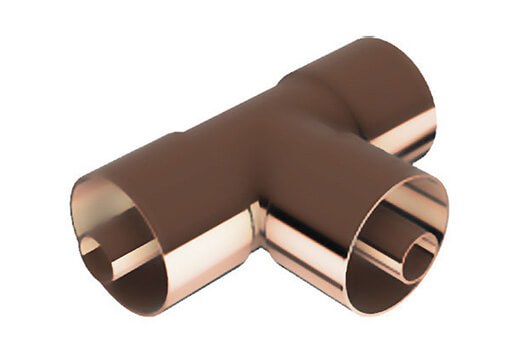
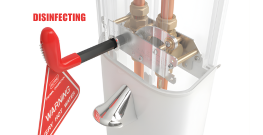
Pipe in a pipe fitting
Case study – Bristol University
There was a requirement for a replacement of a DHWS in a four-storey building with multiple sink and basin outlets on each floor and following discussions with the senior engineer, sustainability, and a suitable contractor, it was agreed to replace the conventional installation with the pipe-in-a-pipe recirculation system.
Prior to replacement of the system, a new calorifier had been installed in 2017 and energy use of the old system was monitored for 7 months. The new recirculation system was subsequently installed and has been continually monitored for over 5 years, starting to provide immediate and long-term benefits for the University of Bristol. In particular, energy consumption prior to the installation stood at 30.18 KwH per day over the December period, and a year later and with the new system installed, this dropped to 16.09 KwH per day; within three years, this figure equated to 16.28 KwH per day. At its maximum, the University of Bristol has seen a reduction in energy consumption and associated carbon reductions of up to 52% with an average of 49.7%.
This installation continues to bring significant cost savings and safety benefits, as well as providing excellent protection against Legionella.
Remote water monitoring
The advent of new and advanced remote water monitoring technologies has revolutionised our ability to oversee water systems across entire facilities with unparalleled efficiency. By harnessing sensors and leveraging IoT (Internet of Things) networks, the process of collecting crucial data has been streamlined like never before. Prior to the implementation of such systems, it was customary for routine inspections to necessitate the physical presence of contractors, often leading to extensive travel between sites – an activity that contributed significantly to the escalating carbon footprint. To quantify this impact, the vehicles employed for contractor transportation emitted approximately 0.05 tonnes of CO2e for every 100 miles travelled, underscoring the magnitude of environmental strain associated with conventional monitoring practices.
The transition to remote monitoring not only addresses environmental concerns but also enhances operational effectiveness. By continuously monitoring water systems, anomalies such as leaks can be swiftly identified, mitigating potential wastage, and preventing costly damage. Through the real-time monitoring of flow events, even minor discrepancies can be detected promptly, potentially saving significant volumes of water that would otherwise be lost. This proactive approach not only minimises operational disruptions but also underscores the pivotal role of technology in promoting sustainability and resource conservation within modern facilities management.
Conclusion
As the urgency of the climate crisis becomes increasingly apparent, so does the imperative for innovation in water-based technologies. From harnessing lost energy from waste water systems to leak detection devices, these advancements not only enhance efficiency and convenience but also embody our collective commitment to a safer and more sustainable future. Through ongoing research and development, we continue to forge ahead in our mission to confront climate change and safeguard our planet for generations to come, perhaps even beginning to reverse our carbon footprint!

About Kimberly
Kimberly is involved in product research and development and has worked on AI clinical washbasins and remote water monitoring systems.