As featured in Waterline Summer 2026
CASE STUDY:
Choosing the WMSoc Legionella Pathway
A ClearFlow Perspective
Linda Hannah M.W.M. Soc MInstLM, Technical Business Manager, ClearFlow Water Treatment Ltd
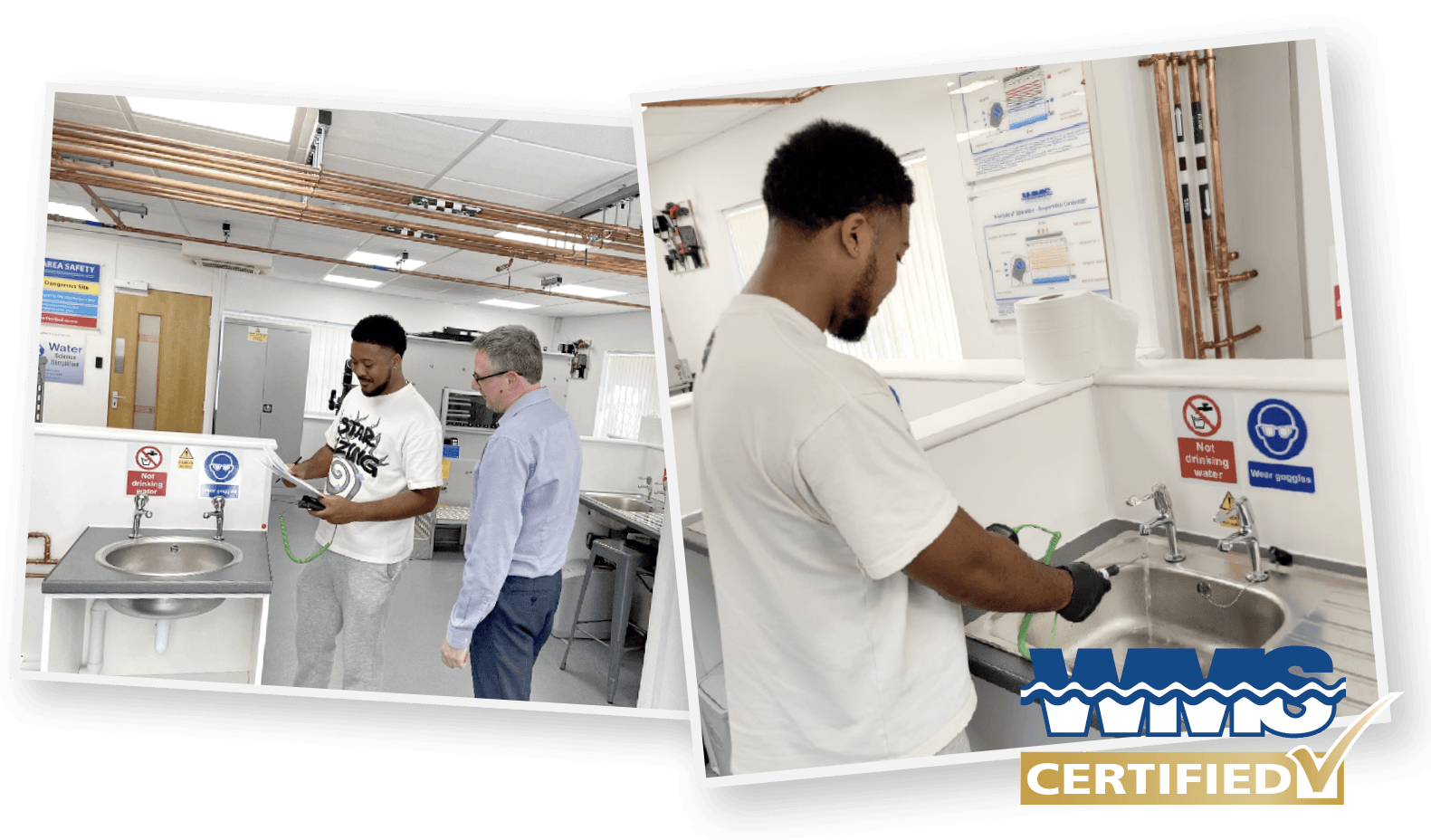
Let me start by offering warm congratulations to Adriano Anjos (Adi) for achieving his WMSoc Certified Qualification, Legionella Risk Assessment WMSoc Cert Pathway. We believe Adi is the youngest engineer to complete this pathway, and everyone at ClearFlow Water Treatment Ltd is incredibly proud of his achievement.
Let me start by offering warm congratulations to Adriano Anjos (Adi) for achieving his WMSoc Certified Qualification, Legionella Risk Assessment WMSoc Cert Pathway. We believe Adi is the youngest engineer to complete this pathway, and everyone at ClearFlow Water Treatment Ltd is incredibly proud of his achievement.
This prompted an important decision, instead of waiting for the “perfect” assessor to appear, we would build one from the ground up. We explored various training routes, but the WMSoc Legionella Risk Assessment Cert Pathway stood out as the most structured, detailed, and progressive option available. Once we understood the framework and its staged approach to competence, the pathway became the obvious choice, and the starting point for Adi’s development as a legionella risk assessor.
Adi began the qualification around 18 months ago, progressing through each stage while working in the field. Recently, we caught up with him to reflect on his experience, what he learned, and why he would recommend the pathway to others.
Adi joined the industry with no prior experience. “I literally started from the bottom,” he explained. “I began with monitoring temperatures, basic sampling, and shadowing engineers so I could understand the fundamentals before progressing.”
This foundation proved essential once he enrolled onto the WMSoc pathway.
“The combination of onsite learning and classroom modules worked perfectly. I’d learn something in the field, then go on the course and understand the theory behind it.”
Over 18 months, Adi rotated between practical site experience and structured training. He credits much of his development to this staged, digestible learning approach:
“Doing it in small chunks helped massively. I wasn’t overwhelmed, everything was spread out evenly.”
“If I didn’t understand something onsite, I’d take photos and ask my senior assessor or the WMSoc tutors. I had support from both sides.”
Adi speaks highly of the WMSoc tutors, training team and facilities:
“Ian and Colin were brilliant, really knowledgeable and patient.”
“The revision days before exams were friendly and relaxed. No pressure, just good support.”
“The practical training room was great. It was setup with tanks, TMVs and components so you can actually practice real scenarios.”
This blend of theoretical and simulated practical learning meant he was well-prepared to apply his skills in realworld environments, including complex systems found in many settings.
Whilst discussing the key learning highlights, the topics that particularly stood out for Adi were:
• Understanding primary, secondary and tertiary loops
• Identifying and differentiating between hydraulic accumulators and expansion vessels
• Gaining deep familiarity with a wide range of water system configurations
• Translating theory directly into day-to-day assessing activities
These are areas where many new assessors struggle, but the structured pathway ensured nothing went “under the radar.”
The pathway culminates in a final exam and assessment. For Adi, this represented a significant personal milestone:
“When I got the certificate, it was a real sense of relief and achievement. All the hard work had paid off. It made me reflect on how far I’d progressed.”
He is now listed as a certified Legionella Risk Assessor on the WMSoc website—a major achievement for someone who joined the industry less than two years earlier.
Far from slowing down, Adi is already planning his next steps.
“I want to do the next courses, Pseudomonas, HTM 04-01, healthcare training. I want to keep building my knowledge and eventually help train others.”
This continued development aligns perfectly with our company’s commitment to nurturing talent from trainee level through to specialist roles.
Our experience with Adi has reinforced the value of the WMSoc pathways route. We consider it:
• Comprehensive
• Well-structured over time
• Balanced between theory and real-world application
• Supportive, with excellent tutors and resources
• A credible and robust route to professional certification
As Adi summarised:
“I’d definitely recommend the course. You learn every aspect properly, and you can apply it straight into your work. I’d even do it again if I could!”
Developing competent, confident Legionella risk assessors takes time, investment, and the right training framework. The WMSoc Legionella Pathways programme offers exactly that.
Adi’s progression from complete beginner to certified assessor in 18 months demonstrates what the pathway can achieve when supported by both employer and training provider.
For organisations struggling to recruit experienced assessors—or wanting to build a stronger, more knowledgeable compliance team, the WMSoc pathway route is, in our experience, an excellent solution.