As featured in Waterline Spring 2026
Desalination as a Strategic Response to Drought in the United Kingdom
Jemma Tennant, Technical Director Caledonian Water Services ltd
Executive Summary
The United Kingdom faces increasing water scarcity due to prolonged dry spells, declining reservoir levels, and growing climate variability. Even regions historically considered wet, such as Scotland, have experienced shortages that disrupted industries as iconic as Scotch whisky, demonstrating that water security is both an economic and cultural issue (SEPA, 2024).
Desalination offers a technically proven, drought independent source of water by removing salts from seawater using Reverse Osmosis (RO) or thermal processes. While widespread globally, particularly in arid regions, the UK has limited experience with large scale desalination (International Desalination Association, 2024). Existing plants in London, the Isles of Scilly, and Jersey provide valuable lessons in operational performance, cost, energy use, and environmental management.
This article explains how desalination works, examines UK case studies, and evaluates whether it should form part of a long term national water resilience strategy.
Introduction: When Drought Hits Home
In the summer of 2025, for the first time in my 24 years living near the River Tweed, I could walk from bank to bank across waters that had once defined the landscape. What had been a strong, steady flow had become a shallow trickle. This was a stark reminder that climate change is no longer a distant concept; it was on my doorstep.
Across the UK, prolonged dry spells and below average rainfall have become increasingly common. In 2025, England and Wales recorded one of the driest early seasons on record, depleting reservoirs and triggering drought warnings (Environment Agency, 2025). Even Scotland, renowned for its rainfall, has been affected. Since 2018, the Scottish Environment Protection Agency has declared moderate to significant water scarcity in multiple regions (SEPA, 2024).
Climate projections suggest these extremes will become more frequent. The Environment Agency’s National Framework for Water Resources estimates that England alone may require an additional five billion litres of water per day by 2055 to meet anticipated demand (Environment Agency, 2020). This is equivalent to 2,000 Olympic sized swimming pools!
Meeting this shortfall will require a combination of reservoir expansion, recycling, demand management… and potentially desalination.
What Is Desalination and Why Does It Matter?
Desalination’s main appeal is simple: it does not depend on rainfall.
For coastal or island communities, that reliability matters. Seawater availability does not fluctuate in the same way reservoirs and aquifers do during prolonged dry periods. Globally, desalination is well established. In parts of the Middle East, it underpins municipal supply, and the technology is both mature and continuously improving.
But in the UK, it remains relatively uncommon. That raises an important question:
Is desalination unnecessary here, or simply underused?
To explore that, it helps to look at the full treatment process.
How Desalination Works: The Full Treatment Process
1. Seawater Intake
Seawater is abstracted via offshore intakes or subsurface beach wells. Coarse screens remove seaweed, shells, and marine organisms, protecting pumps and reducing biological load.
Pre treatment then depends on whether the plant uses Reverse Osmosis (RO) or thermal desalination.
2. Pre Treatment for Reverse Osmosis
RO membranes are sensitive to suspended solids, organic matter, and biofouling. Common pre treatment steps include:
• Coagulation to destabilise fine particles
• Flocculation to form larger flocs
• Dissolved Air Flotation (DAF) or media filtration
• Cartridge filtration for final polishing
DAF is particularly valuable in coastal waters with algal blooms or oil contamination. Cartridge filtration ensures that even the smallest particles are removed before the high pressure RO stage, extending membrane life and reducing energy demand.

3. Pre Treatment for Thermal Desalination
Thermal plants such as Multi Stage Flash (MSF) or Multi Effect Distillation (MED) are less sensitive to fine particles but more prone to scaling. Pre treatment typically includes:
• Coagulation
• Flocculation
• Clarification or sedimentation
• Filtration
• Anti scalant dosing
These steps protect heat transfer surfaces and ensure stable operation.
4. Salt Removal
In RO systems, feedwater is pressurised to 55–70 bar and pushed through semi permeable membranes, producing a freshwater stream and a concentrated brine stream.
Modern energy recovery devices have significantly improved efficiency, but desalination remains more energy intensive than conventional surface water treatment.
Thermal desalination is typically more energy demanding still, although it can be viable where low cost heat is available.
5. Brine Management
RO brine is typically 1.5 to 2 times the salinity of ambient seawater and is discharged through diffusers designed to promote rapid mixing.
Environmental impact depends heavily on proper design and monitoring. With robust modelling and compliance, impacts can be controlled, but they cannot be ignored.
6. Remineralisation and Distribution
Desalinated water is naturally low in hardness and alkalinity. Without remineralisation it can be chemically aggressive and unsuitable for distribution.
Techniques include:
• Limestone contactors
• Lime dosing
These steps restore calcium levels and buffering capacity before final disinfection.
7. Final Disinfection
Following stabilisation, disinfection is applied using chlorine or chlorine dioxide.
• Chlorine is inexpensive and widely used but can form disinfection by products such as bromate.
• Chlorine dioxide is increasingly popular due to its wide pH effectiveness, control of biofilms, and lower formation of trihalomethanes.
Close monitoring is essential whichever method is chosen.
The UK’s Current Position
The UK does not lack desalination entirely; it simply uses it selectively. Three main plants operate in London, Jersey, and the Isles of Scilly, each serving different functions.

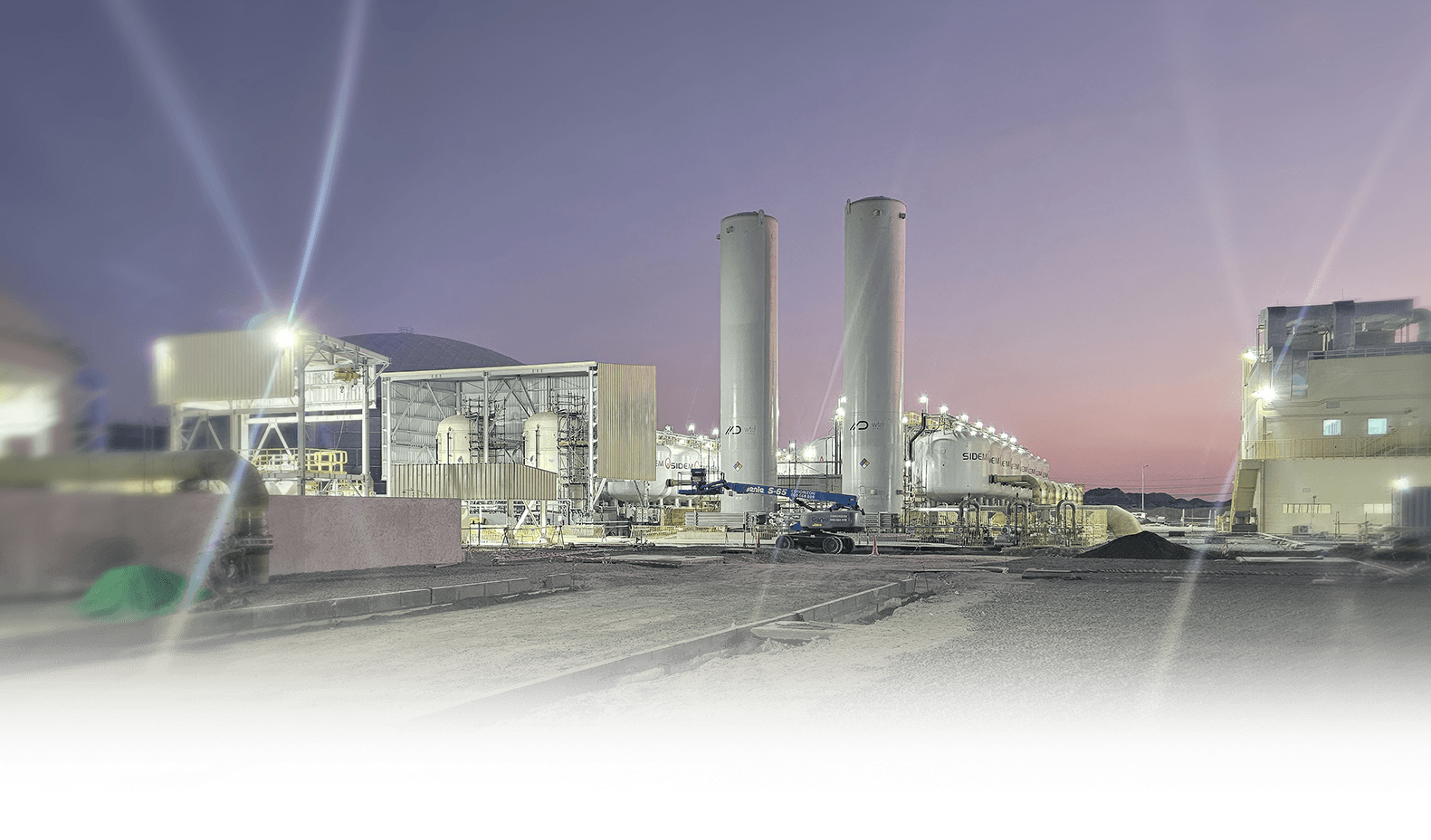
Photos courtesy of Scotmas and Afry Engineering Services. Used with permission. The Hassyan plant in Saudi Arabia under construction. 180MIGD equivalent to the entire daily output of Scottish Water.
Thames Gateway (London)
• Capacity: 150 million litres per day
• Operates primarily as a drought reserve
• High energy costs limit routine use
While some see this as inefficient, it provides resilience during extreme shortages.
Isles of Scilly
With limited groundwater and storage, desalination forms a routine part of supply. Here, alternatives are limited, making RO a practical necessity.
Jersey – La Rosière
This plant operates strategically when reservoir levels fall, supplementing rather than replacing traditional sources.
This hybrid model, based on desalination as reinforcement rather than primary supply, may be well suited for many UK coastal regions.
Before Expanding Desalination
Desalination should not be considered in isolation.
• Leakage across England and Wales remains significant.
• Recovering water already in the system is generally more energy efficient than producing new supply.
• Demand management and water reuse can provide substantial gains.
These measures must be prioritised, but may not be enough to address the projected 5 billion litre daily deficit.
Energy and the Bigger PictureDesalination’s long term viability in the UK will depend heavily on energy integration. If powered by fossil fuels, desalination risks increasing carbon intensity. But coupling desalination with offshore wind and flexible demand operation could greatly reduce emissions.
It’s clear to see that water resilience and carbon resilience are interconnected and must be planned together.
Where This Leaves Us
Desalination is not a simple or cheap option. It brings operational complexity, energy demand, and environmental considerations. But prolonged dry periods are becoming less exceptional. Relying solely on rainfall dependent systems assumes hydrological patterns that may no longer hold.
For island communities, desalination already makes sense. For large urban areas, it may be most valuable as strategic reserve capacity. The more relevant question is not whether desalination is ideal, because it isn’t, but whether the UK is comfortable relying on historical assumptions about future water availability.
If recent summers become the norm, the question may shift from “Should we?” to “Why didn’t we plan earlier?” If we wait until the next severe drought to act, the choices will already be made for us. Planning now gives us options; hesitation only leaves us with consequences.
References can be made available upon request!