As featured in Waterline Autumn 2025
GUIDES FOR HEAT NETWORK SYSTEMS FOR PRODUCING HOT WATER
Prepared by Dr Pam Simpson, Whitewater Technologies
This article originally appeared in the Spring 2023 Analyst, the quarterly journal of the Association of Water Technologies. It is published in Waterline with permission of the author and the AWT.
Overview:
Due to the requirement to be net zero by 2050, energy savings are to be met by construction teams and the use of low temperature heat networks for the production of heating and also for hot water is being driven forward. There are continuous improvements in the specifications of the heat networks and their efficiency. This article aims to summarise key points made in each of the guides to ensure the proposed lower temperature heat network systems will not increase risks associated with the waterborne pathogen, Legionella.
Below are four guides that have been reviewed for the preparation of this article:
• CIBSE Heat Networks: Code of Practice for the UK. Raising Standards for heat supply CP1 2020.
• CIBSE Guidance Note: Domestic hot water temperature from instantaneous heat interface units 2021.
• B1697 NHS Net Zero Building Standards Feb 2023.
• NHS Estates Technical Bulletin (NETB) No 2024/3: Designing safe spaces for patients at high risk of infection from nontuberculous mycobacteria and other waterborne pathogens (27 August 2024).
1 HEAT NETWORKS – CODE OF PRACTICE FOR THE UK CP1 (2020) OVERALL PURPOSE:
The development of heat networks (or district heating) in the UK is increasingly recognised as an important component in the UK’s Clean Growth Strategy: Leading the way to a low carbon future and the decarbonisation of heat, based on Clean Growth – Transforming Heating. This is supported by the Committee on Climate Change in Net Zero – Technical Report (CCC, 2019). Heat networks can address climate change and affordable heat challenges by focusing on the following strategic aims:
(1) to reduce greenhouse gas emissions through the use of a wide range of low carbon and renewable heat sources
(2) to improve security of energy supply by diversifying energy sources for heating and reducing dependence on fossil fuel imports
(3) to offer a supply of heat that is safe, good value, offers the lowest lifecycle cost and contributes to reducing fuel poverty
(4) to provide a heating service that meets customer needs and offers a high standard of customer satisfaction by being safe, reliable, efficient and well maintained.
A major challenge will be to deliver a high standard of service to customers who will have had good long-term experience using gas-fired boilers.
The updated Code of Practice CP1 (2020) is written to:
— improve the quality of feasibility studies, design, construction, commissioning and operation by setting minimum requirements for projects and identifying best practice options
— deliver energy efficiency and environmental benefit service
— provide a good level of customer service
— promote long-lasting heat networks, in which customers and investors can have confidence
This Code of Practice is designed to cover heat networks of any scale. In principle, it applies to any project that involves the linking of heat supply to more than one dwelling or customer, or more than one building. The Code is intended to cover all types of schemes for both existing buildings and new buildings, and for residential, commercial and institutional buildings.
Although many issues are common, networks for new buildings require careful design to keep heat losses low (in percentage terms) whereas the design of networks for existing buildings is often constrained by the existing heating systems in the buildings. Designers may depart from the Code if a different approach is demonstrated to be an appropriate way to meet the overall aims of the Code: safety, low carbon, cost effectiveness, customer service and security of supply.
What is a heat network?
In order to understand the scope of this Code of Practice, it is essential to understand what a heat network actually is. A heat network usually comprises the flow and return pipes that convey heat from a heat source (energy centre) to the customers. The pipes are frequently buried, but they may be above ground or within buildings.
Heat networks include both communal heating and district heating:
— Communal heating is defined as a heat network that serves a single building, with more than one customer (the building does not need to contain the plant).
— District heating is defined as a heat network that serves more than one building (building owners are not necessarily the asset owners).
The following terminology has been used throughout the Code of Practice in order to identify the different parts of the overall heat network:
— primary heat network: the distribution pipes that connect the energy centre to buildings
— mostly buried pre-insulated pipe
— secondary systems: the pipes within the buildings, and up to each dwelling in residential blocks, even if no hydraulic break is installed
— tertiary systems: the dwelling internal circuits, radiators etc., even if no hydraulic break is installed.
A non-domestic building is generally served by primary and secondary systems. An individual house is served by primary and tertiary systems. A block of apartments is served by primary, secondary and tertiary systems.
The Requirements set out in the Guide:
Feasibility
2.4.4 states: The targeted difference between flow and return temperatures on the primary heat network under peak demand conditions shall be greater than 30°C for supply to new buildings and greater than 25°C for existing buildings, to reduce the capital and operating costs of the network, unless a detailed analysis of lifecycle costs and performance shows otherwise.
2.4.7 The network flow temperature shall be sufficient to heat the domestic hot water to the required temperature with good temperature control and to minimise health risks from Legionella growth. Alternative methods of Legionella control may be used to permit the use of lower flow temperatures.
2.4.8 The hot water generation temperature at the instantaneous HIU shall be set to achieve 50°C at the plate heat exchanger outlet, unless there is a particular requirement for a higher temperature. This is a requirement measured at the generating outlet of the instantaneous hot water heating system. These temperatures are acceptable provided the volume of water is small (<15 litres) and the Legionella risk can be controlled. This is supported by CIBSE Guidance Note: Domestic hot water temperatures from instantaneous heat interface units (HIUs) (CIBSE, 2021).
Design:
Minimising health and safety risks is of primary importance in any project. A key role of the designer is to carry out a designer’s risk assessment and then to mitigate any identified risks by taking appropriate design decisions.
3.1.9 states: The design of DHW systems shall follow appropriate guidance in relation to any risks associated with Legionella, in particular CIBSE Guidance Note: Domestic hot water temperatures from instantaneous heat interface units (HIUs) (CIBSE, 2021). Also see HSG274, Part 2 (HSE, 2014a) and HSE Approved Code of Practice and guidance L8 (HSE, 2013).
3.4.7 states: In hard water areas there is a risk that DHW heating coils and plate heat exchangers may scale up, reducing heat transfer and increasing return temperatures. Scaling risk is much reduced if DHW temperatures are below 55°C and if there is turbulent flow at the heating surface. For heating coils in DHW cylinders, where Legionella risk requires higher temperatures (e.g. 60°C) and the flow is not turbulent, the risks of scaling are higher.
3.4.12 All cold water service and potable water pipework shall be insulated to limit heat gain from adjacent heat network pipes, and hence minimise Legionella risk, or where possible they should be installed in separate risers to the heat network distribution.
3.4.16 Heat generated by the HIU:The domestic hot water generated by an instantaneous hot water heating system (e.g. HIU) shall be set to achieve 50°C at the plate heat exchanger outlet, unless there is a particular requirement for a higher temperature. This is a requirement measured at the generating outlet of the instantaneous hot water heating system. These temperatures are acceptable provided the volume of water is small (<15 litres) and the Legionella risk can be controlled. This is supported by CIBSE Guidance Note: Domestic hot water temperatures from instantaneous heat interface units (HIUs) (CIBSE, 2021).
3.4.17 Heat supplied to the customer: The design of the hot water system in dwellings shall ensure that hot water is delivered to the kitchen tap to achieve a minimum of 45°C within 45 seconds of turning the tap on at full flow rate (Figure 1). This is a customer service requirement at the kitchen sink. In non-domestic situations, where there is no kitchen, the designer should nominate a ‘typical’ tap where this requirement should be met.
3.9.12 Heating pipework shall not be run adjacent to or below cold water pipework, in order to keep cold water temperatures low and reduce Legionella risks in the cold water supply.
Operation and Maintenance:
6.1.8 Where centralised DHW systems are used these shall be checked regularly and records kept of any water treatment carried out. The control of Legionella risk is an important consideration and should follow CIBSE Guidance Note: Domestic hot water temperatures from instantaneous heat interface units (HIUs) (CIBSE, 2021). HSE Approved Code of Practice and guidance L8 (HSE, 2013) and HSG274, Part 2 (HSE, 2014a) also need to be followed.
2 CIBSE GUIDANCE NOTE: DOMESTIC HOT WATER TEMPERATURES FROM INSTANTANEOUS HEAT INTERFACE UNITS (HIUS) (2021)
Legislation and guidance on domestic hot water temperatures are unclear for low volume instantaneous hot water heating systems, e.g. using plate heat exchangers within heat interface units (HIUs). This Guidance Note summarises the relevant guidance documents and provides a recommended design approach that is in line with key guidance documents and all functional and safety requirements for instantaneous HIUs.

Figure 1: DHW temperature generated by an instantaneous HIU versus the service actually delivered to the consumer.
The main conclusions of this Guidance Note are:
– GENERATING instantaneous hot water at a temperature of 50°C satisfies the requirements to reduce the risk of Legionella growth and minimise the risk of scalding.
– DELIVERING instantaneous hot water to the kitchen tap at a minimum of 45°C within 45 seconds of opening the tap to full flow rate demonstrates an acceptable service level for users and satisfies the requirement to limit water use.
The risk of Legionella growth will be controlled in line with the requirements of HSG274 (HSE, 2014) when using instantaneous HIUs with a hot water generation temperature of 50 °C. This temperature is optimised to maximise energy efficiency and allow the use of a wide range of heat pump technologies while minimising the risk of scalding.
To the best of CIBSE’s knowledge, this guidance is consistent with Health and Safety Executive (HSE) guidelines current at the time of writing. This Guidance Note presents a unified approach with clear guidance for domestic hot water practitioners. Following this guidance will reduce energy consumption and carbon emissions while ensuring safety and functionality for users. HSG274 Part 2 (HSE, 2014) states that there is a reasonably foreseeable risk of Legionella bacterial growth if:
• water is stored and/or recirculated
• the water temperature in all or some parts of the system may be between 20°C and 45°C
• there are deposits that can support bacterial growth, and
• it is possible for water droplets to be produced and, if so, they can be dispersed.
Traditionally, hot water systems in the UK have included water storage, i.e. calorifiers. Risk mitigation approaches have been set accordingly, with temperature used to reduce the risk of Legionella growth. However, this is not required for instantaneous systems with high rates of turnover.
HSG274 requires that risk assessments should be performed for all domestic hot water systems.
HSG274 Part 2 (HSE, 2014) states that systems with low volumes of water storage (e.g. instantaneous HIUs) are lower risk systems:
2.68 Low storage volume heaters (i.e. no greater than 15 litres) such as instantaneous units and POU [point of use] heaters, may be generally regarded as lower risk.
The guidance within HSG274 Part 2 is that such systems:
• should be able to achieve a peak temperature of 50°C to 60°C, and
• temperatures less than 50°C should only be permitted where there is high turnover (or alternative control).
Lower risk scenario
This scenario has been agreed with the HSE as a lower risk system.
Block of flats served by communal heating system and communal boosted cold water system.
Each dwelling/flat has its own low volume HIU to generate instantaneous hot water.
There is no stored hot water, and each HIU contains less than 15 litres of water.
Current practice in countries with established heat network markets
Looking to mature heat network markets in other countries, there is evidence that suggests that high hot water temperatures are not required. As an example, Danish standard DS 439 (Dansk Standard, 2009) sets a 50°C tap temperature requirement for domestic hot water, with the option of dropping to 45°C during peak periods.
Current practice in the UK
There were 604 confirmed cases of Legionnaires’ disease in England and Wales in 2023 (Public Health England, 2023). Of these cases, 35.1% were associated with international travel. Of the domestic community cases 62.7% were associated with community exposure to cooling towers, spa pools and other sources. Only 2.2% of cases were associated with healthcare settings.
A study by the Energy Saving Trust in 2008 showed that less than 50% of the combi boilers in the study were generating hot water at or below 50°C, with around 35% generating at below 48°C (see Figure 2) (Energy Saving Trust, 2008). Given that there were approximately 13 million combi boilers in the country in 2011 (DECC, 2013) but only a relatively limited number of cases of Legionnaires’ disease, it would appear that operating domestic hot water systems at these temperatures does not pose a significant Legionella risk. However, it is noted that Legionnaires’ disease disproportionately affects vulnerable groups, and the distribution of these groups within the Energy Saving Trust sample is unknown.
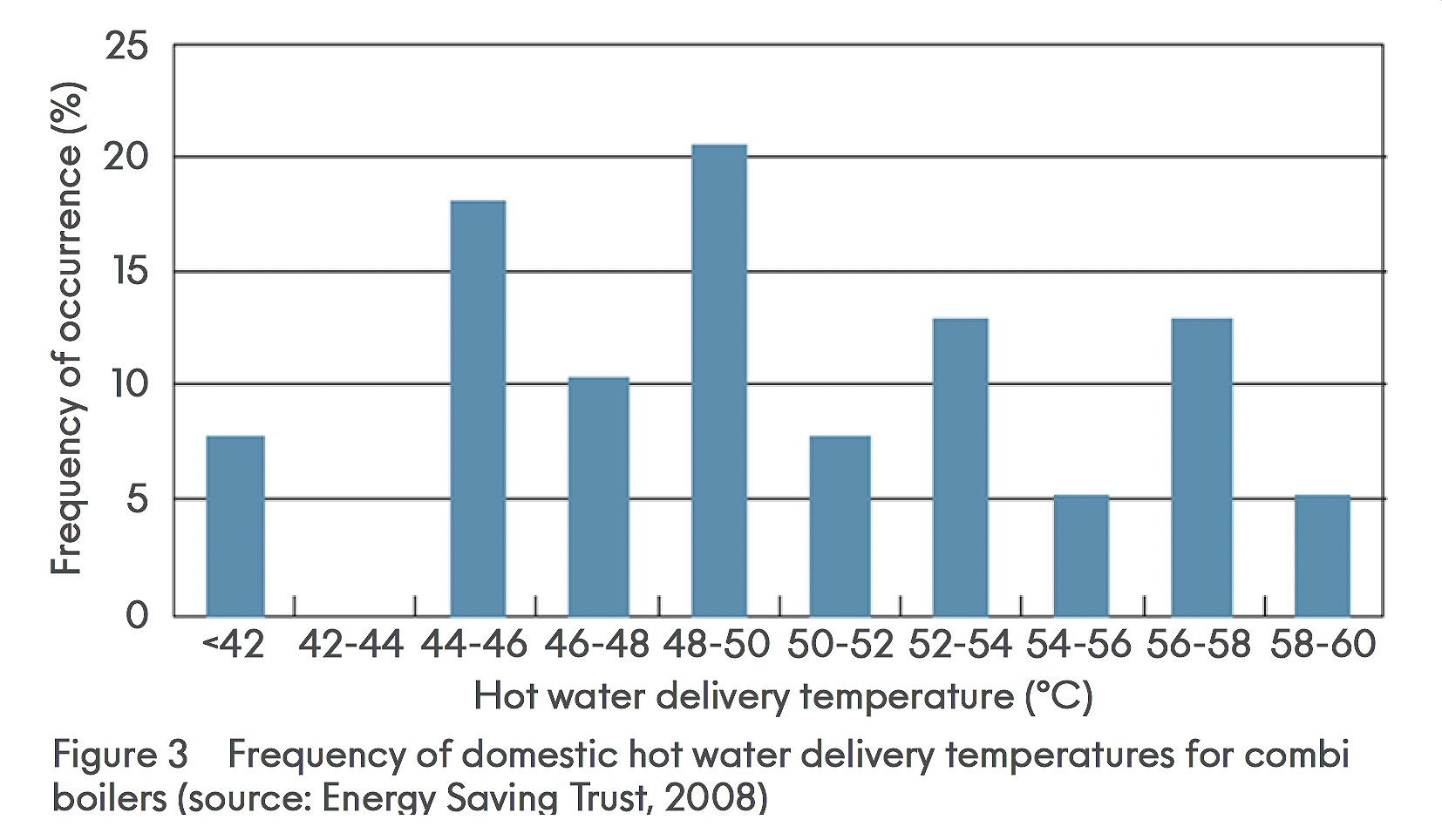
Figure 2: Frequency of domestic hot water delivery temperatures for combi boilers.
Generating instantaneous hot water at a temperature of 50°C satisfies the requirements to reduce the risk of Legionella growth in typical practice and minimise the risk of scalding. Risk assessments for hot water systems serving vulnerable users should be suitable to their needs and consider both scalding and Legionella.
7.3 Limescale
Limescale is caused by the deposition of calcium carbonate that is naturally dissolved in water. When water is heated, the calcium carbonate comes out of solution and forms limescale on hard surfaces with which the water is in contact. Limescale reduces the performance of equipment by impeding water flow and heat transfer. This effect is particularly pronounced in HIUs in hard water areas, where the concentration of calcium carbonate in tap water is higher.
Calcium carbonate is unusual in that its solubility decreases as the temperature of the water increases. This means that the rate of calcium carbonate deposition or limescale build-up is increased at higher temperature. Figure 7 (in the guide) shows that there is more than a 10% increase in the solubility of calcium carbonate when the water temperature is reduced from 55°C to 50°C (Coto et al., 2012). This implies an equivalent reduction in the rate of limescale build-up. This reduction will reduce the maintenance burden and extend the working life of taps, shower heads and heat exchangers (e.g. within HIUs), as well as improve the long-term energy efficiency of heating systems.
8 Conclusions and recommendations stated in the Guidance Note
Following a review of key guidance documents and consultation with relevant parties, it is concluded that 50°C hot water temperatures generated from instantaneous HIUs can be used without compromising safety or user function. Typical practice of providing hot water at a temperature of 55°C or higher increases the risk of scalding, has a significant impact on capital cost, energy consumption and carbon emissions, increases limescale deposition and adds to the risk of overheating. This practice should be avoided.
A best practice approach to low volume instantaneous domestic hot water generation is as follows:
GENERATION – Domestic hot water setpoint should be 50°C at the point of generation.
DELIVERY – Supply of hot water at the kitchen tap should be at a minimum of 45°C within 45 seconds of opening the tap to full flow rate, rising to 50°C within a reasonable time after that.
PIPEWORK – Hot water pipework should be the minimum size and length possible to deliver the required blended temperature at the tap.
This approach will minimise carbon emissions while maintaining user safety and functionality.
3 NHS NET ZERO BUILDING STANDARD 2023 Domestic hot water (DHW) performance targets
While DHW is not included as part of the compliance requirements for the operational Energy Limits element of the Standard, setting targets on delivery efficiency and circulation ensures that regardless of the source, the distribution of DHW will be highly efficient.
5.60 Hot water usage within healthcare varies greatly dependent on the proposed departmental usage. In some instances, the volumes of hot water used can fall significantly short of those suggested in initial calculations. The following DHW system targets are required by the Standard:
• minimum distribution efficiency of 95%. (This includes the distribution and storage systems only; from the outlet of the heat generation plant to the intake of the hot water outlet. Efficiency of pumps and heat generation is separate to this efficiency)
• storage vessel with a minimum of 50 mm factory insulation
• target storage temperature should be 55ºC where possible, making allowance for the system to be able to increase the temperature periodically to eliminate risk of Legionella.
4 NHS ESTATES TECHNICAL BULLETIN (NETB) NO 2024/3: DESIGNING SAFE SPACES FOR PATIENTS AT HIGH RISK OF INFECTION FROM NONTUBERCULOUS MYCOBACTERIA AND OTHER WATERBORNE PATHOGENS (27 AUGUST 2024)
Aims
This technical bulletin aims to enhance the current HTM 04-01 (2016) to ensure new projects for the development or refurbishment of spaces intended for patients at increased risk of all waterborne infections are designed, constructed and commissioned so that they minimise the risk of harm from exposure to water, sprays or aerosols derived from water, wastewater systems and associated equipment as far as possible.
Whilst this technical bulletin is focused on new build and major refurbishment projects, the information provided will be helpful for use in existing buildings where the infrastructure allows, to protect patients at high risk of water and wastewater infections, following risk assessment by those with the competencies, skills and experience to carry out such an assessment and agreed by the WSG.
Hot and cold water systems
3.41 All hot- and cold-water systems should be designed to keep cold water at a temperature below 20°C and hot water distributed so that it reaches the outlets at 55°C within seconds (typically well within 15 seconds). The minimum temperature as it returns to the hot water generating plant should be not less than 55°C to prevent growth of NTM, and should be maintained at all times. For localised hot water provision, a local plantroom with a plate heat exchanger(s) will ensure target hot water temperatures for health premises as described in HTM 04-01 and HSG 274 part 2.
3.42 In areas where it can be predicted there will be intermittent use (for example, patient en-suites, where risk assessment allows their installation), automated flushing devices can be set to flush all outlets at time intervals agreed by the PWSG. Microbial profiling and remote temperature monitoring may be needed to establish flushing frequencies.
Cold water supplies
3.47 For cold water supplies, historical evidence should be sought to determine the highest incoming supply water temperatures (usually towards the end of summer although higher than average spring temperatures may result in increases over 20°C occurring earlier). Where temperature data suggests incoming temperatures are likely to rise above 18°C (to allow for a maximum of not more than 2°C above that measured at the incoming water supply at the property boundary and the effects of climate change (BS 8680)), design risk assessments should consider the cooling of the incoming supply water (HSG 274 part 2).
Hot water systems
3.50 Systems should be designed to deliver hot water with no risks to patient safety, i.e. no potential for stagnation or delivery of water below 55°C at the outlet.
3.51 Hot water delivery requirements to protect patients from NTM infections are more stringent than those specified in HTM 04-01 and HSG 274 part 2 for healthcare premises. For example both HTM 04-01 and HSG 274 state that hot and cold water systems should be maintained to keep cold water, where possible, at a temperature below 20°C and [hot water] distributed so that it reaches the outlets at 55°C. However, in the smaller systems described as suitable for these at-risk patients, the temperature of water delivered at the outlet or entry into a thermostatic mixing valve (TMV) (where the risk assessment states they are required) should be reached and maintained within seconds of turning on the tap.
3.52 To protect against NTM growth, the flow from the hot water generating plant must be ≥60°C and a minimum return of 55°C.
3.53 An integral plantroom should be located within the module with a hot water generating plant to provide local supplies of safe hot water with circulating target hot water temperatures at 60°C to ensure satisfactory maintenance of hot water temperatures throughout the module and facilitate 55°C at each outlet.
3.57 Where risk assessment allows, water from wash-hand basins should be blended at the outlet with a simple mixing device and a physical stop to prevent scalding rather than using TMVs (see HTM 04-01 Part A for further guidance on manual taps with a physical stop).
4.13 At handover, the water delivered at each outlet and the associated equipment must meet all the specified target parameters as defined both within the Water Supply (Water Quality) Regulations 2016, the agreed specification and the PWSP. Legionella, P. aeruginosa and NTM should not be detected pre- and postflush as the incoming supply has been filtered and disinfected.
5 Additional Considerations and Emerging Approaches
While the reviewed guidance documents provide a strong foundation for the safe and efficient use of low-temperature heat networks, there are a number of areas where further clarity and innovation can strengthen practice:
Compliance and referencing
It is important for the reader to place industry guides such as the CIBSE Code of Practice into the wider compliance framework. A structured “compliance roadmap” that references statutory water law such as COSHH and the Water Supply (Water Fittings) Regulations at the beginning of the roadmap. This will help practitioners understand the hierarchy of requirements and is a key tool when evaluating a pathway to compliance and Net Zero. It avoids over-reliance on industry guidance alone, which, while informative, does not carry statutory weight in legal proceedings.
Emerging technologies
Recent advances in heat pump and water generation technologies are beginning to overcome some of the limitations noted in current practice. Refrigerants such as R290 (propanebased technology) are capable of delivering higher domestic hot water (DHW) temperatures more efficiently, while brine-based systems (as an alternative to glycol) are under development and show promise for more sustainable operation.
Atmospheric water generators with integrated heating also offer a novel approach, particularly for smaller or decentralised systems. In addition, the use of electric top-up or “boost” systems—ideally coupled with renewable generation—provides a pragmatic way to intermittently achieve higher water temperatures where required for compliance or infection control.
Where higher temperatures are required other carbon offsets using solar and wind systems can be considered to help with the burden of energy consumption while battery systems can help provide this energy when required and offer redundancy in system design and operation.
Valves and regulatory pinch points
Thermostatic mixing valves (TMVs) remain a requirement in many domestic and commercial settings, yet they do not always operate reliably under the parameters of lowtemperature heat networks.
This presents a compliance challenge. Exploring alternative valve technologies, or system designs that employ careful zoning, may provide pathways to ensure both safety and compliance while maintaining system efficiency.
Maintenance and hygiene management
Experience across large estates suggests that once heat interface units (HIUs) or other complex valve arrangements are colonised, they are difficult to disinfect effectively. Design simplicity, system accessibility, and whole-life asset management therefore need to be considered alongside theoretical efficiency gains.
Reducing system complexity can significantly lower microbial risk and maintenance burden. There are multiple requirements under CDM 2015 to be met by project teams and careful planning with industry experts is required.
Monitoring and under-reporting
It should be acknowledged that Legionnaires’ disease is often underreported, and the true burden may be higher than official figures suggest. It is commonly accepted that testing of contracted Legionellosis is inaccurate further compounding the reporting issues.
This underlines the importance of adopting proactive monitoring strategies. New approaches such as remote temperature logging, automated flushing protocols, and microbial profiling are becoming available and could provide a valuable additional layer of assurance in higher-risk settings.
With the continued focus on Climate Change there is significant rise in buildings testing positive for bacteria, compounded by the need for thermally efficient buildings and hot water services not reaching accepted temperatures for microbiological control. This creates a domino effect of failures seen in modern design.
Water quality and scale control
Scaling remains a critical risk factor, particularly in hard water areas. If untreated, limescale deposits compromise both Legionella control and the efficacy of biocides, as well as undermining manufacturer warranties. A robust strategy for pretreatment and scale protection should be considered an integral part of system design.
Scale in time can affect the efficiency of a system lowering temperatures in systems. Scale can affect other engineering controls such as the use of certain biocides to control microbiological loading of a system.
Socio-economic and resilience factors
Heat network adoption is also shaped by socio-economic realities. In some communities, systems will not be installed or maintained despite low capital cost, due to affordability barriers. This creates a risk of uneven infrastructure, where localised failures can have far-reaching consequences across a district system. Good system design, careful zoning, and competent designers are essential to build resilience and prevent widespread disruption.
Retrofifitting challenges
The application of low-temperature heat networks in existing buildings remains particularly challenging. Retrofitting often requires coordinated upgrades to building fabric, system zoning, and staged implementation strategies in order to deliver both compliance and efficiency. Addressing these challenges openly will help practitioners plan more realistic and resilient pathways to net zero.
IN SUMMARY:
The following summarises what the guides state for each section. Overall, the Guides recognise the requirement to control Legionella within water systems and refer to HSG 274 Part 2 and its guidance on control temperatures:
Domestic:
• The network flow temperature shall be sufficient to heat the domestic hot water to the required temperature with good temperature control and to minimise health risks from Legionella growth. Alternative methods of Legionella control may be used to permit the use of lower flow temperatures.
• The low temperature heating for hot water is for <15 litre systems. This can be achieved either by the use of a combi-boiler or by heat exchangers with short pipe runs.
• In apartments/ office blocks etc, individual heat exchangers are to be installed to each apartment to provide 50°C water to the unit. This is taking into account the risk of scalding. Instant hot water at 50°C satisfies the requirements to reduce the risk of Legionella in practice and also reduces the risk of scalding.
• Scaling remains a critical risk factor, particularly in hard water areas. If untreated, limescale deposits compromise both Legionella control and the efficacy of biocides, as well as undermining manufacturer warranties. A robust strategy for pretreatment and scale protection should be considered an integral part of system design.
• Scale is less soluble at lower temperatures hence preferring to maintain temperature below 55°C and if there is turbulent flow at the heating surface. (This also reduces the possibility of Legionella establishing on scale deposits within pipework or outlets.)
• It is intended to achieve 45°C to the kitchen tap in 45 seconds when on full flow, rising to 50°C thereafter.
• Heat pumps to be set at 50°C. However, if temperature higher than 50°C are required, the range of heat pump technologies is reduced and the energy savings may reduce. Recent advances in heat pump and water generation technologies are beginning to overcome some of the limitations noted in current practice.
• Heating pipework should not be adjacent or below cold pipework to reduce Legionella growth in the cold water pipes. All cold water services shall be insulated to limit heat gain.
• A risk assessment for hot water systems serving vulnerable users should be suitable to their needs and consider both scalding and Legionella exposure, e.g. care homes, student accommodation.
Hospitals:
• The guidance available is primarily focused on domestic applications. However, challenges become more complex in non-domestic settings, such as healthcare, commercial catering, and hygiene-critical environments, where more complex water law and standards apply. Explicitly recognising these differences is essential to avoid unintended compliance failures and to ensure that system design aligns with sector-specific risks and requirements.
• There is currently no new HTM/SHTM guidance on the use of heat networks. It is generally accepted that heat networks are to be used, wherever possible, due to the requirement for NHS to be net zero by 2050 (B1697 NHS Net Zero Building Standards Feb 2023).
• If cold water is to rise above 18°C, risk assessments should consider the cooling of the incoming supply water.
• Guidance states storage hot water should be 55°C at the outlets within 15 seconds There should be an allowance to increase the temperature to 60°C to eliminate the risk of Legionella and NTM growth.
• The use of filters on mains water will reduce bacteria entering and rapid turnaround of water should prevent Legionella establishment.
• In areas of intermittent use, automated flushing devices can be set to flush all outlets to prevent microbial establishment.
• Again, with continued improvements in heat network efficiencies and their ability to offer higher water temperatures, the target to reach net zero by 2050 will be achieved whilst maintaining a low risk to Legionella.