As featured in Waterline Summer 2025
How can Water Treaters Benefit from Recent Peer-Reviewed Data on Legionella Testing Methods?
By Jeff Bates, IDEXX Laboratories
This article originally appeared in the Spring 2023 Analyst, the quarterly journal of the Association of Water Technologies. It is published in Waterline with permission of the author and the AWT.
Water treaters are primary actors in the fight against waterborne disease due to their role managing premise plumbing systems and Legionella risk. Unfortunately, guidance on Legionella risk management is often limited or unclear, especially around interpreting the results of environmental Legionella sampling. A key contributing factor is the fact that traditional Buffered Charcoal Yeast Extract (BCYE) methods for Legionella detection, such as ISO 1131 and the CDC method, are inaccurate and highly variable. To address these challenges, new methods for Legionella detection have been introduced. Both PCR and liquid culture methods have been extensively studied in peerreviewed literature. The available research demonstrates that PCR can be effectively used as a negative screen to rule out the presence of Legionella in the case of a negative PCR result. Eleven peer-reviewed studies also demonstrate that liquid culture is more sensitive than traditional BCYE methods, and there is strong evidence that liquid culture provides more consistent results than BCYE methods. These findings may be the basis for improved guidance in the future. In the meantime, water treaters can use these insights to benefit from these new methods, provide better risk management to their customers, and ultimately better protect public health.
Introduction
Building owners and facility managers increasingly look to water treaters to manage Legionella risk. The general public is becoming more educated on Legionella, in part due to the well-documented increases in the recorded incidence of Legionnaires’ disease around the world. Perhaps more important and troubling is that the overall number of waterborne disease outbreaks in the U.S. is increasing due to Legionella (Figure 1). After many years of decline in waterborne illnesses driven by improvements in drinking water regulation and operation, Legionella and other biofilm-associated pathogens are driving increases in hospitalizations and deaths in the U.S., with an estimated annual cost of $2.39 billion in 2014 (1).
While there are environmental consultants and other industry players that address Legionella risk in premise plumbing, customers look to water treaters, almost by default, to manage this risk. Anecdotally, many water treaters now require their customers to test for Legionella or waive any claim to liability if they decide not to do so. Water treaters are now perhaps the primary line of defense against Legionella, and therefore against increases in waterborne disease in the U.S.
Guidance on Testing for Legionella
Despite this important role of protecting public health, water treaters consistently contend with incomplete and unclear guidance on how to best manage Legionella risk and control Legionella growth. These challenges are especially pronounced with respect to testing for Legionella.
The water treatment industry is generally aligned that testing for Legionella in both cooling towers and premise plumbing is best practice for reducing risk. The AWT’s 2019 position statement on Legionella outlines that, although water management teams can decide whether to perform environmental sampling as part of a water management plan, “Legionella testing is the only direct or “active” way (currently) to validate (water management) program effectiveness” (3). Unfortunately, guidance from the Centers for Disease Control and Prevention (CDC) is less clear— it suggests that routine testing may be beneficial in facilities that are unable to consistently meet control limits (4). A water treater might only realize that most facilities fall into this category after seeking out experts or through experience in the field.
Guidance on how to interpret Legionella test results is also confusing. The CDC aims to provide a multifactorial approach based on Legionella concentration, changes in concentration, and extent of positivity. Unfortunately, the CDC’s complex, chart simply boils down to a handful of factors that suggest poor control of Legionella. There is little to no discussion of the intersection between concentrations, growth, extent, and type of Legionella. If Legionella is shown to be poorly controlled, readers are instructed to perform a complex set of tasks that ends in “considering” whether remedial treatment is needed (4).
This leaves many water treaters and their customers without a clear sense of how to interpret results or best mitigate risk.
In the Technology Supplement to the Fall 2017 Analyst, M. Freije (5) provided additional guidance on interpreting results, noting these factors to consider: 1. “breakdown of findings” (e.g., where samples were collected or whether they were pre- or postflush); 2. equipment-specific remediation; and 3. occupant susceptibility. He provides a strong framework for interpreting results, including examples of how the different factors may interact. Interpreting results is inherently a complex task; however, and specific guidance on every factor and every interaction goes beyond the scope of an Analyst article. While Freije’s article is a good start, water treaters looking for clear guidance on interpreting Legionella test results must still seek out other experts or learn through experience.
The inability to provide clear guidance on testing for Legionella and interpreting Legionella test results is an outcome of several factors, including lack of definitive data on the infectious dose of Legionella and susceptibility of potential hosts (6). Deficiencies in traditional methods for detection of Legionella (e.g., Buffered Charcoal Yeast Extract (BCYE) or spreadplate methods) are also a major contributor to unclear guidance. As outlined by the EPA:
Despite a number of published procedures for the detection of Legionella in water samples, standard culture methods remain limited by their sensitivity and unreliability in detecting a wide range of Legionella spp. on a consistent basis…
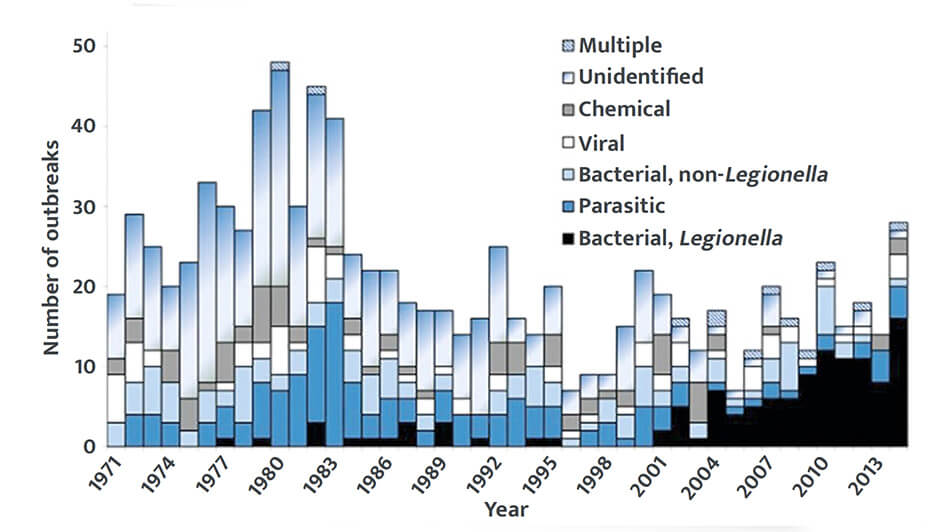
Figure 1: Etiology of reported drinking water associated outbreaks in the United States (n = 298) by year, 1971 to 2014. Source: Reference 2, NASEM (2020).
These limitations make interpreting results difficult. Logically, test results that are inaccurate and inconsistent are difficult to interpret. Unfortunately, BCYE-type spread-plate results (often referred to as “traditional” or “standard” culture) have been shown to be both inaccurate and inconsistent.
BCYE Culture Challenges
Perhaps the clearest demonstration of those shortcomings is a study performed by researchers at the CDC in 2011 (7). Samples with known concentrations of Legionella were sent to 20 CDC Environmental Legionella Isolation Techniques (ELITE) laboratories to evaluate laboratory limits of detection as well as the accuracy of Legionella counts. The samples that were distributed were either positive (seeded with Legionella), negative, or “variable.” Variable samples were either seeded with low levels of Legionella or contained high levels of competing bacteria in addition to Legionella.
The study uncovered two key findings. First, CDC ELITE laboratoriesA using spread-plate culture methods incorrectly identified 37% of variable samples as negative. This is a significant rate of false negatives, especially considering these variable samples approximate real-world samples. Practically, this data suggests that monitoring facilities or cooling towers with spread-plate culture methods may provide a false sense of security and inaccurately characterize risk.
The second key finding was that when laboratories identified samples as positive, they underestimated the amount of Legionella in positive samples by over ten-fold, or 1.25 logs, with more than a thousand-fold variability, or 3.57 logs. This level of inaccuracy once again highlights that monitoring with spread-plate culture methods can underestimate true Legionella risk. It is also important to highlight the implications of such a high level of variability. If results can be so variable, it becomes more obvious why no federal agency or standards organization is willing to provide concrete guidance based on those results.
The CDC study evaluated the different factors that could have led to such a high rate of false negatives and such extreme variability in results. The researchers evaluated sampling protocol, treatment, incubation, and experience level as possible factors influencing accuracy and consistency. Ultimately, the CDC found that none of these factors explained the inaccuracy and inconsistency seen in results, and that “the observed variability in enumeration by both U.S. and EU laboratories is probably due to the inherent inconsistency in assessing a sample by culture techniques.” In this case the researchers refer specifically to BCYE spread-plate culture methods.
The findings in the 2011 CDC study are corroborated by other studies. Boulanger and Edelstein (8) found that spread-plate methods recovered a maximum of 53% of Legionella, and Díaz-Flores et. al. (9) found that 20% of samples evaluated by spreadplate culture were inconclusive, “making effective risk management impossible.” A smaller study of inter-lab variability by Freije (5) demonstrated between 120 and 145% variability in results between different laboratories, with 22% of samples categorized as over 10 colony forming units per milliliter (CFU/mL) by one lab and under 10 CFU/mL by another.
This poor method performance and the resulting difficulty in interpreting testing results can have a real impact on water treaters. Meaningful risk to customers and water treaters alike can go unaccounted for, and Legionella remediation can be stymied by poor or inconsistent results. Given these consequences, water treaters may rightly ask, “could improved methods lead to more clarity when interpreting Legionella results?”
Several new methods for the detection of Legionella have been introduced, promising to address certain challenges associated with traditional BCYE spread-plate culture testing methods. To understand the impact these technologies could have, discerning water treaters will look to peer-reviewed literature to understand the performance of these new methods. While the discussion below is not an exhaustive review of all new Legionella methods, it summarizes research on key technologies that have been extensively studied and referenced in Legionella guidance, including ASHRAE Guideline 12B (10).
Legionella Detection by PCR
One technology that has been extensively proposed as a potential way to improve environmental sampling of Legionella is molecular detection or polymerase chain reaction (PCR) technology. PCR tests isolate and replicate specific sequences of DNA. Tests can be designed to detect Legionella species, Legionella pneumophila, and/or L. pneumophila SG1, and measuring the replication process provides a relative measurement of the amount of DNA in the original sample. A key advantage of the test is that it can be performed in a matter of hours vs. the days required to culture Legionella.
Because PCR has been so extensively proposed as a Legionella test, an exhaustive literature review is beyond the scope of this article. However, several studies have demonstrated that PCR has a high negative predictive value for Legionella (11-14), meaning that samples that are negative by PCR are highly likely to be negative by culture. Certain studies have demonstrated 100% negative predictive value, meaning that all samples negative by PCR analysis were also negative by culture (11), but others did not reach that mark (12), and the figure has varied by water type, reaching as low as 70% for potable water in one study (13). However, in general using PCR as a negative screen and confirming any positives with a culture test appears to be an accepted practice. It is recommended by the CDC (4), and successfully used by the New York Department of Health (15).
PCR is often recommended for use in conjunction with culture testing and not as a standalone test. A key reason is that PCR routinely returns more positive results than a culture. In a review of 28 studies, Whiley et. al. (16) found that 72% of PCR results were positive for Legionella, while only 34% were positive by culture. In an especially stark example, drinking water samples in New York City were tested by both PCR and liquid culture. Eighty-five percent of those samples were positive for Legionella by PCR, but only 2.8% were positive by culture (17). Several studies have acknowledged that one factor in increased PCR positivity is that the technology detects DNA from dead and non-viable Legionella cells. A culture confirmation is recommended in order to discern whether a positive result represents viable Legionella that may pose a health risk, or dead Legionella that has been successfully remediated.
Researchers have been working to overcome this obstacle for several years. They have focused on eliminating positive results due to non-viable Legionella with two compounds: propidium monoazide (PMA) and ethidium monoazide (EMA). In brief, both substances penetrate the membranes of dead cells, but not living cells. PMA and EMA then bond with the DNA in those cells when exposed to light. DNA that bonds with PMA or EMA will not provide a positive PCR result, so PCR combined with a PMA or EMA treatment has been evaluated to measure only viable Legionella. These compounds have been extensively evaluated for this purpose, with studies dating back to at least 2006 (18).
Unfortunately, a review of these studies does not lead to a definitive conclusion. Using PMA and EMA to eliminate DNA from non-viable Legionella from a sample assumes that viability correlates with whether the membranes of the cell can be penetrated by these compounds, but this has not been well studied. Certain studies have suggested that EMA can penetrate some cells with intact membranes, and that only PMA should be used for determining viability (19). Another study, however, found that EMA provided better results for Legionella specifically (20).
Both substances require a light source to bond to DNA, but high levels of suspended solids or other biomass could keep light from reaching the entire sample (19). This may be a possible explanation for a study that found that EMA reduced the number of Legionella positives in bathing water, but not in cooling tower water (21), which is notoriously dirtier and more turbid. Other studies did not find significant differences between detection of untreated and heat-treated samples when using PMA, suggesting the compound may not be able to completely discriminate between live and dead bacteria (22). In general, the field has not yet aligned on the use of PMA or EMA for detecting viable Legionella; even studies that returned impressive results still advocate that PCR should be confirmed with culture (20). Whether EMA and PMA can be used with PCR to detect only viable Legionella appears to require additional research.
This lack of definitive data is highlighted by the Veteran Health Administration’s (VHA) decision to allow PCR for use only as a negative screen. As stated in VHA Directive 1061 (23):
If a water is negative by PCR, then further processing of that sample by culture is not required and the sample can be considered “negative for Legionella detection”… For samples that are Legionella-positive by PCR, the following requirements apply: The PCR-positive water sample must be processed by a culture method (in accordance with laboratory selection criteria) to confirm living Legionella are in the sample. While some PCR tests claim ability to differentiate between living and dead Legionella, such designations are not sufficiently reliable and use of the PCR result to determine that the Legionella are living is not permitted.
Other aspects of PCR tests for Legionella that require more study are the impacts of inhibition on test results. PCR reactions may be adversely affected by substances in a Legionella sample, and PCR studies have detected measurable inhibition in up to 46% of samples (12).
Additionally, PCR provides a result in genomic units (GU). While several studies have tried to correlate GUs to CFU action limits, cutoff values have varied by matrix and laboratory (13, 24, 25), making uniform guidance impossible.
Despite these challenges, it is well acknowledged that PCR testing can greatly simplify and accelerate Legionella testing when used as a negative screen, as described above. Additionally, there is at least one ongoing study on whether different compounds can enhance PCR to only detect viable Legionella, and water treaters should review any future research with an eye towards how PCR could impact the field of Legionella testing.
Legionella Detection by Liquid Culture
Another method that has been introduced for Legionella detection is liquid culture, also referred to as the most probable number (MPN) method or the bacterial enzyme method. In this method, the sample is combined with a reagent containing nutrients to promote L. pneumophila growth, selective agents to suppress growth of non-Legionella organisms, and a substrate. Actively growing strains of L. pneumophila use this substrate to produce a brown color indicator that signals a positive result.
This greatly simplifies testing when compared to traditional BCYE spread plate methods. In brief, BCYE spread plate methods require the analyst to use his or her judgement to choose from several sample treatments, from filtration, to acid and heat treatments, which may reduce Legionella recovery. The output from these treatments are then plated on solid media, and again the analyst must choose between different formulations. Suspected Legionella colonies are then confirmed via streaking on additional solid media. Liquid culture testing maintains the benefits of culture testing, but significantly simplifies the process by culturing bacteria in a liquid medium, as described above.
In order to provide a quantitative result, the liquid culture test is performed by pouring the mixed reagent and sample into an incubation tray with 96 wells. The wells are physically separated from each other so that each well contains a separate reaction. Positive wells are used to estimate the number of viable bacteria in a sample: an MPN result. MPN results are equivalent to results in CFUs (26). Tests based on MPN results are used around the world and are accepted by regulators in over 50 countries. As of the writing of this paper, there is only one commercially available liquid culture test for L. pneumophila: the Legiolert test.
Liquid culture has been extensively compared to traditional methods for Legionella detection in peer-reviewed literature. To date, there have been 11 studies that directly compare the performance of traditional methods to the liquid culture method in environmental samples (27-37). While the specific method compared varies slightly across these studies, all compared methods were based on BCYE spread-plate procedures, including the protocol sometimes referred to as the CDC Method (although the CDC does not endorse any specific method). The most frequently compared method was ISO 11731. ISO 11731 is likely the most common BCYE method used worldwide and is stipulated for use in several global regulations and in the state of New York.
Each of these studies evaluated liquid culture against the BCYE method in real world, routine environmental samples, eliminating any bias or impact associated with laboratory-grown Legionella, which often behave very differently than Legionella that grow “in the wild.” In total, the studies evaluated 2,085 samples across 7 countries in North America, Europe, and Asia. A total of 20 labs participated across studies and included researchers from the U.S. Environmental Protection Agency (EPA), the Italian Ministry of Public Health, and major Legionella testing labs in the U.S., including EMSL. The studies were published in 10 different scientific journals with an average impact factor of 3, generally meaning they are well-respected publications. Four of the studies applied the rigorous criteria set out in ISO 17994: Requirements for the comparison of the relative recovery of microorganisms by two quantitative methods (38).
The primary finding of nearly all studies was that liquid culture is a more sensitive and accurate method for detecting L. pneumophila than BCYE methods, including ISO 11731. Ten of the eleven studies ran statistical analyses to determine whether the liquid culture method was statistically more sensitive than traditional methods. Nine of those ten studies found liquid culture approaches to be more sensitive in at least one type of water or with at least one statistical test. All studies found that the liquid culture method had at least equivalent sensitivity to BCYE methods across all water types and statistical tests, and none of these studies found BCYE methods to be more sensitive. While a complete meta-analysis of these studies is beyond the scope of this article, the liquid culture approach identified 1,083 positive samples in the studies where this data was made available, while traditional methods only identified 918. In multiple studies, the liquid culture method identified certain samples that were above relevant action limits, when the traditional method returned a negative result. These examples represent instances where monitoring with traditional methods would have left building occupants at risk and where liquid culture appropriately identified that risk. When taken together, the studies demonstrate that liquid culture is a more sensitive and accurate test for L. pneumophila than traditional, BCYE-based methods.
Several studies provided possible explanations of why liquid culture may provide a more accurate result than traditional BCYE methods. Many researchers have identified interference from non-Legionella organisms as a key challenge in reading BCYE plates, especially in non-potable samples. Because liquid culture isolates each individual reaction, interference is minimized, and counts are more accurate. Researchers from the EPA analyzed 15 samples where L. pneumophila could not be identified due to overgrowth of non-Legionella bacteria on BCYE plates. Liquid culture found high concentrations of L. pneumophila in those same samples. This is important as it indicates that there can be serious Legionella risk that is missed when plates are overgrown with non-Legionella organisms, a relatively common occurrence.
The studies also highlighted that many of the treatments involved with BCYE methods that aim to minimize the growth of non-Legionella bacteria also likely reduce overall Legionella counts. And finally, the studies point out that because Legionella is a waterborne bacteria, it may grow better in a liquid medium than it does on solid agar plates, as has been found with certain other bacteria (39, 40). The exact mechanisms of improved sensitivity and accuracy have not been adequately studied, but the above explanations for the improved performance of liquid culture are certainly logical given what is currently known about Legionella and the two test methods.
Seven of the studies referenced in this article provided measurements of the specificity of the liquid culture method for L. pneumophila—in other words, whether or not the method produces false positives. All studies found that the liquid culture method had acceptable specificity, between 96 and 100% (27-29, 33-35, 37) All microbiological methods produce some level of false positives, including BCYE-based methods (41). Despite this fact, all study authors suggested that liquid culture is sufficiently specific for the purposes of Legionella detection. As stated by researchers from the EPA, “In the present study, there was no evidence of interference by non-target microorganisms when using the (liquid culture) method” (28).
Another peer-reviewed paper also attempts to add to the body of knowledge on the specificity of liquid culture, authored by researchers from Special Pathogens Laboratory (42). In this study, sterile water was inoculated with laboratory-cultured pathogens at various concentrations and tested by liquid culture. Some of these tests resulted in false-positive results. Unfortunately, this study has little relevance for water treaters or water management team decision-makers, as laboratory cultured pathogens in sterile water are well recognized to behave differently than pathogens in environmental samples collected from building plumbing, cooling towers, and other relevant sources. There is a large body of peer-reviewed literature that demonstrates a low false-positive rate in liquid culture in environmental samples (27-29, 33-35, 37), which is significantly more relevant than limited experiments in sterile water. The paper also conflicts with other studies- for example, the NF Validation performed by the Association Française de Normalisation (AFNOR) found no crossreactivity of one of the pathogens included in the study by Hirsch et. al., despite the bacteria being present at higher levels (43).
As detailed previously, consistency in results is at least as critical as accuracy when water treaters interpret Legionella results. Unfortunately, standard practices for comparing two methods, especially by ISO 17994, focus primarily on sensitivity and specificity, and not consistency. There is therefore limited peer-reviewed data on whether the liquid culture method provides more consistent results than traditional spread-plate methods. The liquid culture method does, however, eliminate many of the sources of variability in BCYE methods. Concentration, pretreatment(s), media formulation, and subjectivity in results interpretation all have the potential to be significant sources of variation in BCYE methods. Liquid culture eliminates all those sources of variability with one set procedure for potable water and one for non-potable water, combined with objective results interpretation. Indeed, liquid culture achieved the best possible measure of repeatability in its ISO 13843 validation report. While further study could provide additional insights, it is highly likely that liquid culture provides significantly more consistent results than traditional BCYE methods.
Finally, two of the studies of liquid culture evaluated the test against traditional ISO methods not only for the detection of L. pneumophila, but also for the detection of Legionella species. The liquid culture test is specific to L. pneumophila, the primary pathogen that causes Legionnaires’ disease and does not detect non-pneumophila species. Despite this fact, two studies found liquid culture to be statistically equivalent to ISO 11731 for the detection of all Legionella species (29, 37). These findings demonstrate that liquid culture is so superior for the detection of L. pneumophila that it maintains equivalence with traditional methods even when nonpneumophila positives are included in the positive count of the traditional methods.
A detailed discussion of the importance/non-importance of detecting nonpneumophila Legionella species is beyond the scope of this article but has been covered in various publications (44-46). Monitoring exclusively for L. pneumophila has been accepted by public health officials in at least 4 countries, however, this continues to be a topic of debate in many others. As outlined by researchers from the Ministry of Public Health in Italy, “routinely monitoring only for the most pathogenic species of a bacteria is already an established practice. For example, Pseudomonas aeruginosa is routinely monitored, rather than all species of Pseudomonas” (22).
It is important to note that the liquid culture method’s improvements in sensitivity, accuracy and consistency come with all the standard benefits of any culture test. As discussed above, MPN and CFU results are interchangeable, and an MPN result can be directly evaluated against an action limit in CFUs. Additionally, the liquid culture method produces in a viable isolate that can be saved and further tested for serotype or genetic sequence, immediately or in the future. This further testing can be critical in identifying whether a cooling tower, building, or other water feature was or was not the source of an outbreak or infection. The New York Department of Health specifically identified the liquid culture method as “essential” for the isolation of clinically relevant strains (15), and liquid culture has been shown to have improved performance for obtaining isolates in outbreak investigation (47).
Closing Thoughts
As demonstrated here, an in-depth reviewof peer-reviewed literature can provide a wealth of insights and can deepen a water treater’s knowledge of microbial methods and Legionella in general. Even more important, water treaters can act on these insights to improve service to their customers, and therefore better protect public health. Two primary insights from the above research are:
1. PCR can provide an effective negative screen.
2. Liquid culture provides more accurate and consistent results than traditional BCYE-based methods of Legionella detection.
Knowing that PCR testing can provide a rapid negative screen allows water treaters to work together with their laboratory partners to quickly rule out Legionella risk, in the case of a negative result. PCR testing can also be used after a Legionella remediation to evaluate whether it was successful, potentially allowing a customer to reopen a building sooner than would otherwise be possible. Positive results can be confirmed with a culture test prior to taking any additional actions. In general, using PCR as a negative screen can deliver more immediate peace of mind to a water treater’s customers and can quickly rule out risk.
Knowing that liquid culture provides more accurate and consistent results than BCYE-based Legionella detection methods such ISO 11731 also has important implications. Water treaters that work with their laboratory partners to monitor Legionella risk in their customers’ facilities with liquid culture are more likely to avoid the false negative results associated with traditional spread-plate methods, and therefore more likely to provide an accurate characterization of risk. In the case of a retest or multiple rounds of testing associated with a remediation, liquid culture can eliminate the variability associated with spread-plate testing, providing more insight into what is happening within water systems, and more confidence in results.
Additionally, using a liquid culture method to detect and quantify Legionella risk can eliminate one of the important causes of incomplete guidance around interpreting Legionella test results. In the long term, this should ultimately lead to improved guidance from experts and governmental organizations. For example, increased confidence that a negative result is a true negative could enable more reliance on that result as a measure of risk. Lower variability in results could allow water treaters to interpret any increase in Legionella concentrations as a true indication of increased risk, and not just an anomaly created by method variability. Updating guidance, however, is usually a long process and water treaters that understand the most recent research can benefit from these findings well in advance of adjustments to guidance.
Despite their critical role in protecting public health, water treaters routinely contend with incomplete or confusing Legionella guidance. This is due to several gaps in the science of when and how Legionella infections occur, as well as the use of highly variable and inaccurate BCYE test methods. Researchers are constantly advancing the state of knowledge around Legionella and Legionnaires’ disease. At the same time, water treaters now have less variable, more accurate methods at their disposal, and water treaters can look to peer-reviewed literature for insights on how those new methods can enable better Legionella risk management. Those who act on those insights will provide better service, and ultimately better protect their customers and the public.
Endnotes
A CDC ELITE Program: This program allows laboratories to test their Legionella isolation techniques against a set of standardized samples. The CDC ELITE Program identifies laboratories that are able to isolate (grow and identify) Legionella from a water sample using a traditional BCYE culture method. Earning an ELITE Certificate does not guarantee that at other times a laboratory will be able to isolate Legionellae from every sample in which they are present, because the ability to find Legionella in a sample can be affected by the quality of the sample the laboratory receives.
B Other environmental testing methods may be an appropriate component to a Water Treater’s testing plan but have not been extensively covered in peer reviewed literature. For example, lateral flow technology may provide a very fast presence absence result as an on-site test but has not been extensively studied by the field.
C As of the writing of this article, there is only one commercially available liquid culture test for L. pneumophila: the Legiolert test, which is available from IDEXX Laboratories, Inc. (Westbrook, ME).
Jeff Bates is the strategic marketing manager for Premise Water at IDEXX. In his role, he is responsible for promoting testing for waterborne pathogens in premise plumbing systems globally and the IDEXX culture tests Legiolert and Pseudalert.
He holds a bachelor’s degree in environmental studies from Middlebury College and received his MBA from the Darden School of Business at the University of Virginia.
Mr. Bates can be contacted at:
[email protected].
REFERENCES CAN BE MADE AVAILABLE UPON REQUEST.