Chaput D, Clarkson K, Bagrade L, Marek A, Kelly D, Watson D, Steele T, Leanord A. Water Research, 282, 2025, 123748, ISSN 0043-1354. https://doi.org/10.1016/j.watres.2025.123748.
Highlights:
- Following a 3- year closure of a paediatric haemato-oncology ward, water testing showed high total viable counts (TVCs) in over 20 % of samples and elevated counts of numerous Gram-negative bacterial species (GNBs) in 73 % of samples, despite daily flushing and continuous chlorine dioxide dosing.
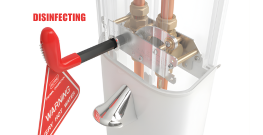
- The study aimed to measure the impact of three sequential interventions (system disinfections with chlorine, then silver stabilised hydrogen peroxide (SSHP), followed by thermostatic mixing tap replacement (TMT)).
- Of the three sequential interventions, SSHP treatment and TMT replacement were more impactful than chlorine alone, though a cumulative effect cannot be ruled out.
- The influence of flushing and ward cleaning could not easily be quantified but are also likely to have contributed to the overall reduction in microbial counts.
- Since the ward reopened to patients in 2022, there has been no return of the high microbiological counts observed immediately after reconstruction, however 0.2 μm point-of-use water filters have been deployed.
- GNBs have been detected sporadically, and the few found in samples post 0.2 μm point-of-use filters are more likely to be from retrograde contamination.
Read the full paper HERE